[…] I entered the grounds of Independence National Historical Park as I wandered through the heart of downtown Philadelphia. Only, I did not enter through the main gate, but through a back entrance, pushing a gate that was not closed, without knowing what was beyond. I was then, for a few moments, the ideal spectator of what was taking place before my eyes, not being aware of the role-playing that was going on. If I did not recognize all the characters played by the actors posted at the crossroads of two small roads, waiting for the next flight of tourists, it appeared to me clearly enough that the paunchy man, cane and tricorn in hand, must be Benjamin Franklin. I followed him with my eyes as he joined another group of actors. I photographed him as a paparazzi, or a spy, would with the longest lens I had on me. My confusion grew at a certain point, as I didn’t know if I was observing the actor playing Benjamin Franklin breaking bread for the pilgrimage tourists to look at, or if I was simply observing the actor, on lunch break with his colleagues, standing back from Carpenters’ Hall. I made a photographic diptych of this encounter. The second image differs from the first by the modification of the overall color tone, which is produced by a simple drag of the cursor in the Photoshop software (Image – Adjustements – Hue).
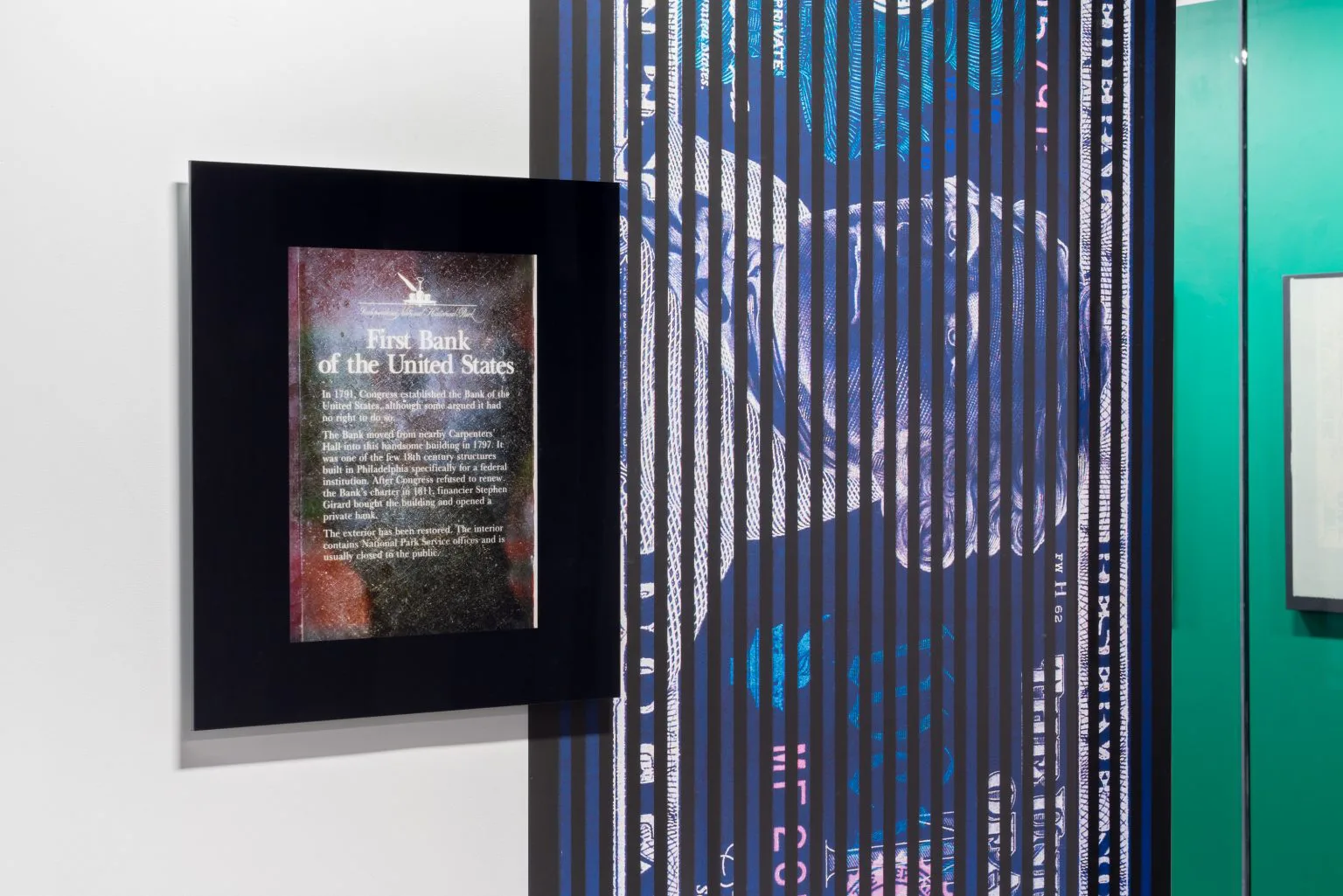
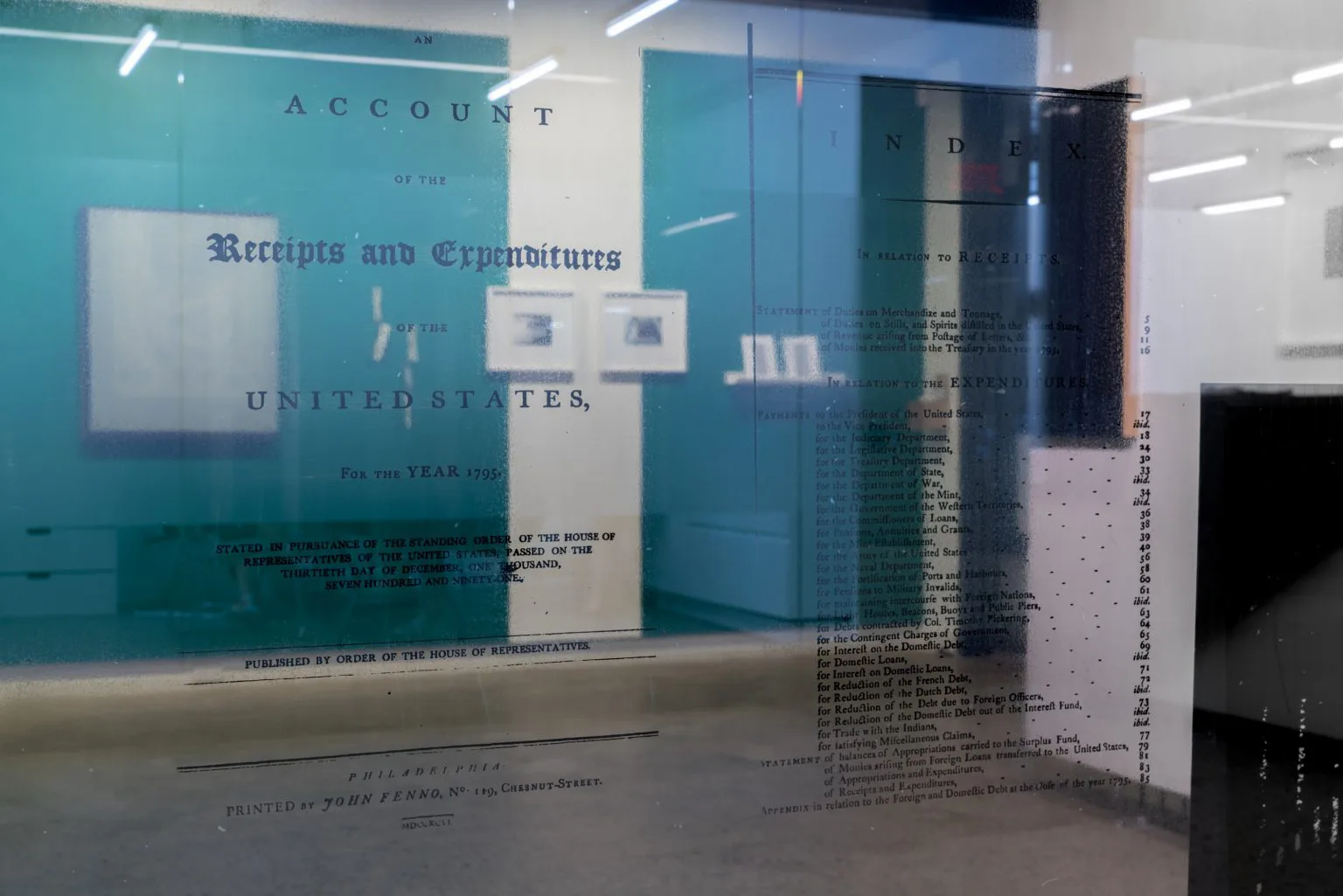
I mentioned that I entered the Independence National Historical Park site by pushing a poorly closed gate. I was trying to get to the back of the First Bank of the United States building. I had photographed the front of the building for over an hour, taking in various details of its façade. The history of America’s first central bank is summarized on two commemorative plaques; two dark rectangles, located on either side of the entrance to the First Bank. These plaques are duplicates of each other, copies. In fact, they are not so much plaques as clear vinyl stickers, produced with a desktop printer and mounted between the glass panels of the windows. Although I could see into the vacant interior of the first floor through the tiles with the interpretive texts, my photographic documentation of the commemorative plaque was inevitably hampered by the density of the reflective glass surfaces, the dullness of the sticker and the accumulation of dust and scratches in the tiles. In the eye of my camera, the printed sticker, presumably from Staples, was transformed into an etched stone stele. By shifting the frame of the image to include a portion of the mullion, the glass panel became the heavy, worm-eaten leather binding of a great book of scriptures.
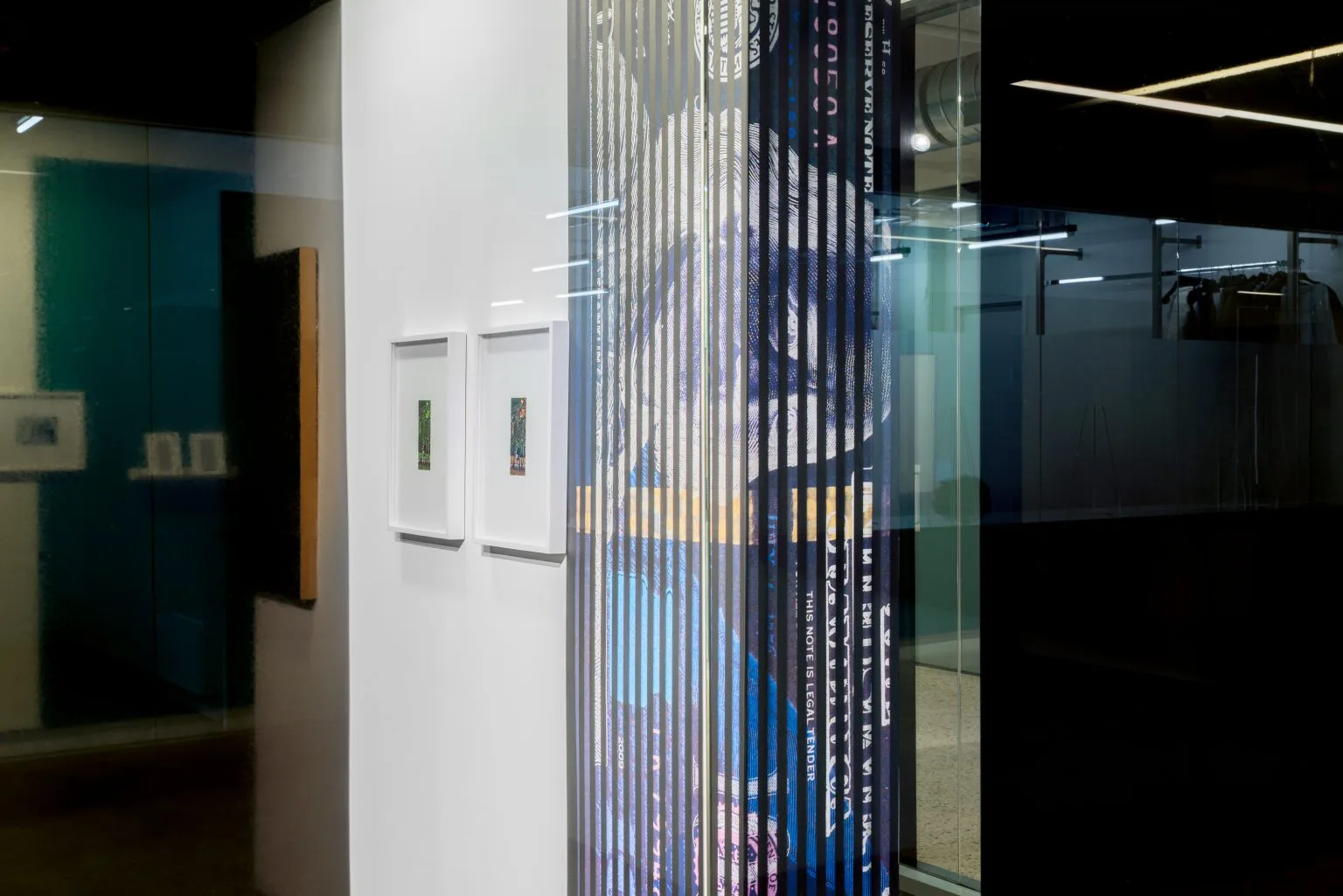
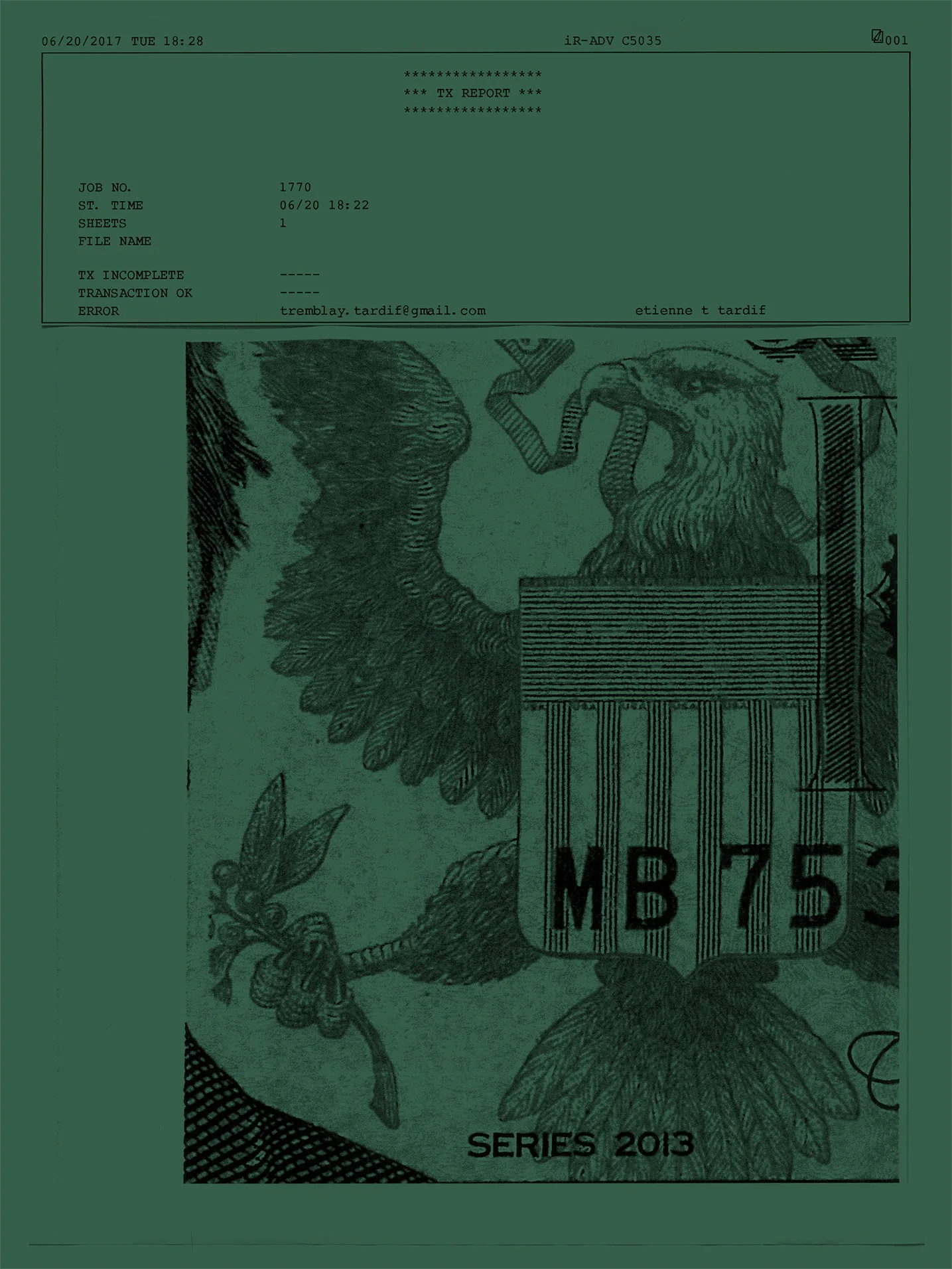
I could not enter the bank, nor could I capture its dark interior. The same could be said of the Canon Imagerunner Advance copier that, the day before, laced the banknote reproductions I was trying to enlarge with white stripes; superimposing an iconoclastic graphic system on the supposedly transparent mimicry of portraits, seals, coats of arms, serial numbers and guilloche. It is explicitly written on the copier not to reproduce items such as passports, checks or bank bills. I then scanned the enlarged copies of the bills and sent the files to my Gmail box. It was not without a touch of dread that I looked at the report that came out of the copier’s jaws: it reproduced the image in question and detailed my name, my email address, the time and date of the scan. I suspected that no one was monitoring the real-time flow of images between the Canon copier and my Gmail address that day. However, the TX Report was there, the files encoded, encrypted metadata stored somewhere – filed, indexed somehow. In whose hands had the information fallen: Canon, Google, the federal government? […] – Étienne Tremblay-Tardif
Through the use of text and image reproduction techniques, Étienne Tremblay-Tardif develops a materialist and research-oriented practice, in which he articulates the opacities and transparencies of knowledge and vision. In his work, he focuses on highlighting the textures and contexts of visualities produced by devices of different natures, where body and discourse, old and recent technical devices, as well as institutions and infrastructure intersect and interface.
Étienne Tremblay-Tardif is an artist and lecturer at UQAM’s École des arts visuels et médiatiques. He completed studies in art history and film studies at the Université de Montréal (BA 2006) before undertaking visual arts training at Concordia University (BFA 2009, MFA 2013). He was the recipient of the Albert-Dumouchel Prize (2007) and several grants for creation and artistic research (Concordia University 2009/2010, Crsh 2010, CALQ 2014/2106/2018/2020, CAC 2017/2021). Over the past few years, he has notably participated in the exhibitions Soulèvements (Galerie de l’UQAM, 2018), Open Edition (Carleton University Art Gallery, 2017), Monuments aux victimes de la liberté (AXENÉO7, 2015), L’avenir / looking forward (Biennale de Montréal / MACM, 2014), Collision 9 (Parisian Laundry, 2013) and Ignition 7 (Galerie Leonard & Bina Ellen, 2011). His studio work often extends into critical essays accompanied by elaborate montages: Unsplash (Galerie UQO 2020, Aauc 2019), Notes (Concordia University 2018), Signage Matrix (School of the Art Institute of Chicago 2015, School of Visual Arts 2014).
Presence of the artist
Thursday, May 13th, from 3PM to 7PM
Saturday, May 29th, 3PM to 5PM
Saturday, June 19th, 3PM to 5PM