Open to the public
Friday, July 5, 1:30 pm to 6:30 p.m. (permanent Tucker)
Thursday, July 11, 12h to 6:00 p.m.(permanent Raphaëlle)
Saturday, July 20, 12h to 6:00 p.m. (permanentTucker)
Wednesday, July 24, 12h to 6:00p.m. (permanent Raphaëlle)
Open by appointment only groulxjulien.raphaelle@gmail.com et tuckerkapp@gmail.com
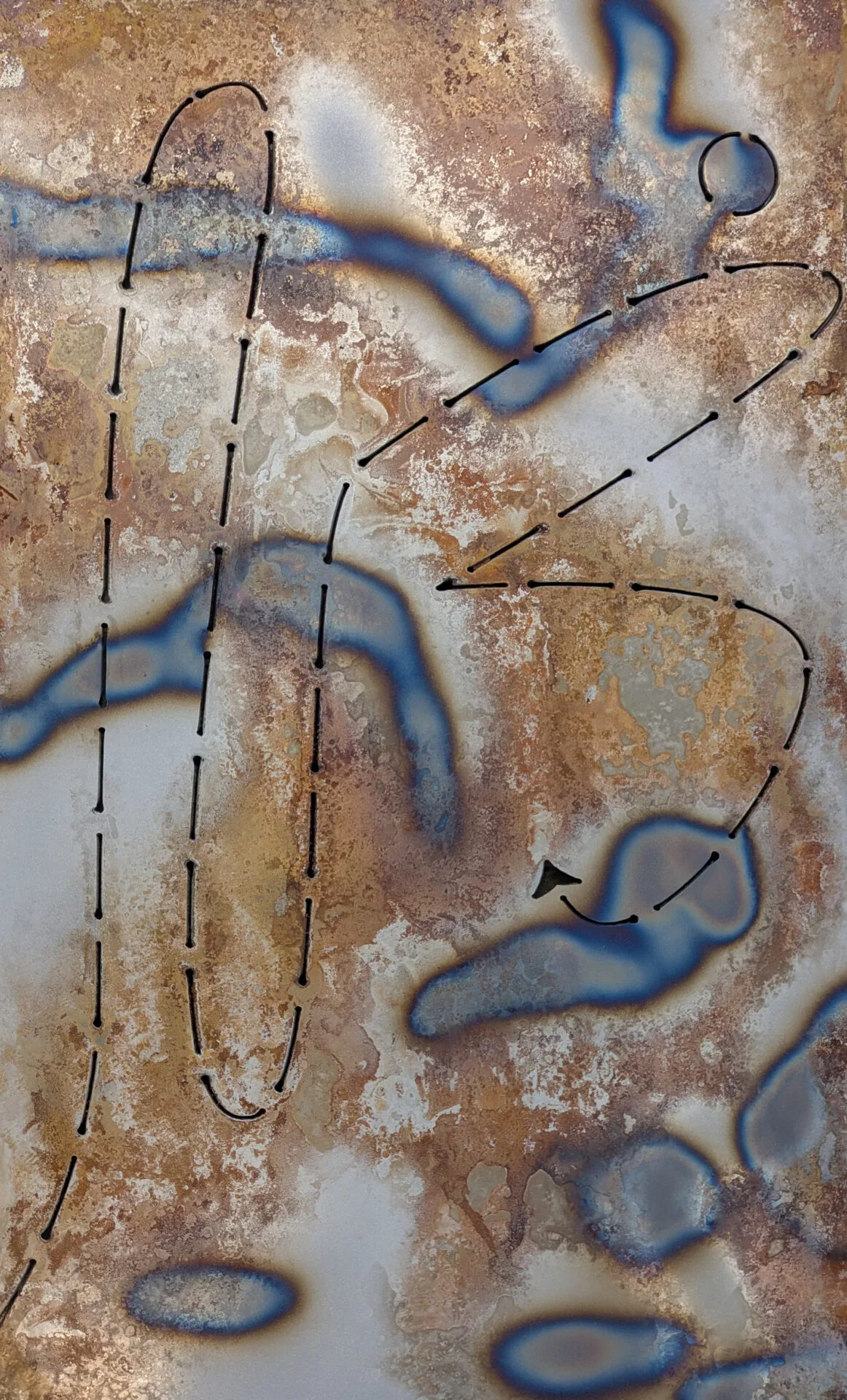
Atelier Circulaire is pleased to announce the exhibition Sampling reality, presented by Raphaëlle Groulx-Julien and Tucker Kapp at the end of their year-long research and creation residency at Atelier Circulaire. Raphaëlle Groulx-Julien and Tucker Kapp are respectively recipients of the François-Xavier Marange 2022 and 2023 grant.
Sampling reality is an evolutive co-exhibition by Raphaëlle Groulx-Julien and Tucker Frederick Kapp.
The act of sampling aims to study something small and specific before extending an interpretation towards more general hypotheses. The very essence of sampling lies in this dialectical tension, this conversation, between the particular and the universal seen as landscapes of the real. Sampling reality is thereby pleonastic: you can only sample something real.
The task seems impossible—taking a handful of individuals to represent a society or coring a few cubic meters of the seabed to analyze and qualify its immensity seem as haphazard as reading tea leaves. And yet, as samples accumulate, they enable us to dig in, represent, figure and touch the particularity and immensity of reality.
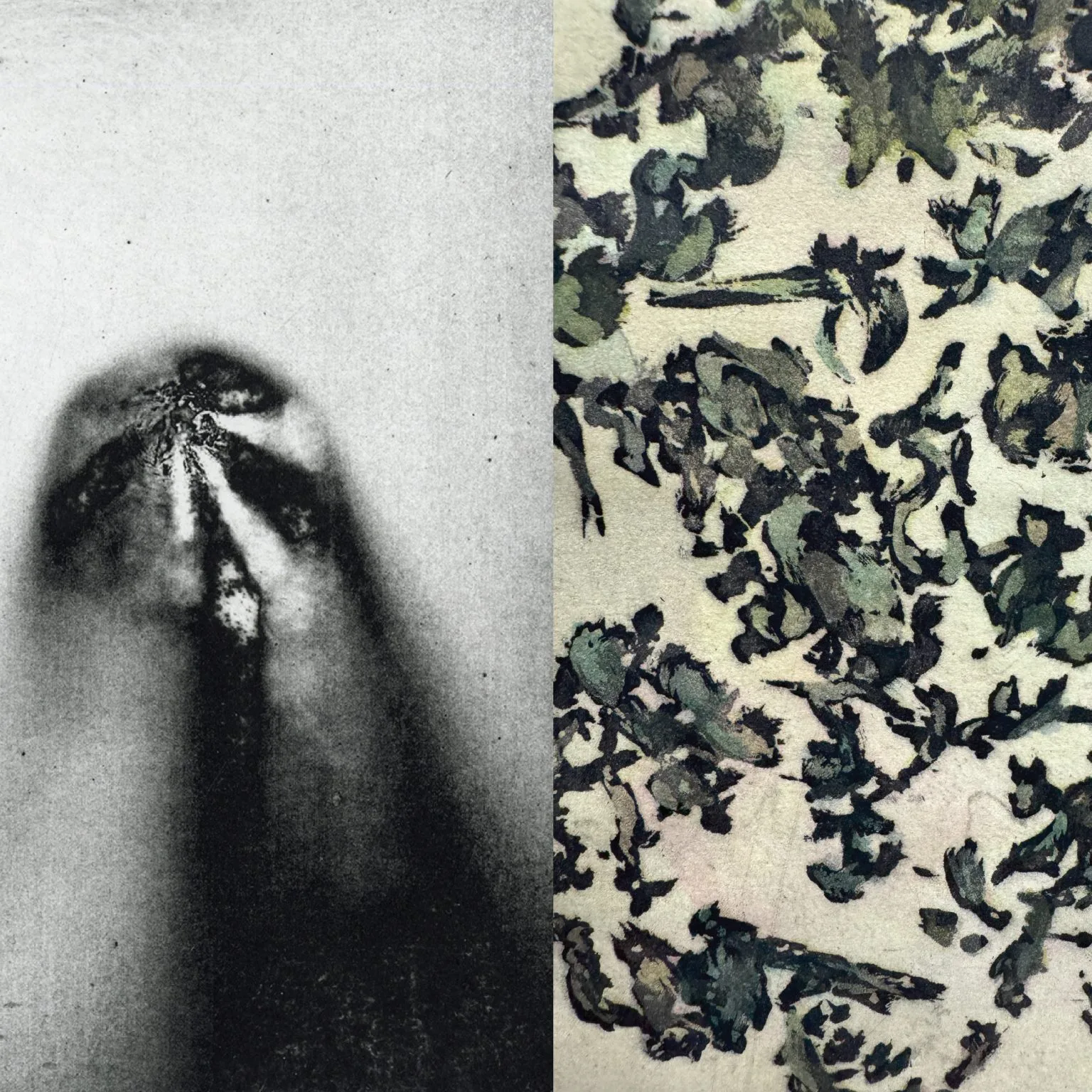
In my practice, I question the relationship between the image and its materiality, the link between the abstract reading of the visual and the concrete nature of the object. During this residency, I wanted to work on the idea of dissolution, the possibility of matter disintegrating so as to mingle with other materials. The project took the form of an exploration of the representation of brewing tea leaves. I was initially attracted by the plant-like geometry of the leaves, the depth-of-field effect between the surface on which the tea floated and the bottom of the cup, the warm colors, the gradual coloration of the liquid, the development of the leaves and their constant movement, the effects of bubbles and vapors. Beyond the visual, soothing nature of a miniature landscape, my senses were stimulated by the pleasant smell of a liquid I was about to swallow. This seemingly simple subject underlines the limits of the visual in the sensory apprehension of the world. I used etching and aquatint with highlights in watercolor and oil paint, as well as end wood engraving, to render different materialities of different teas, and thus emphasize the non-final character of the image. Above all, these images remain iconographic, perceptible only to the eye. So I’m also crossing them with ceramics: does drinking tea from cups featuring an image of these infusions influence the consumption of the image on the wall?
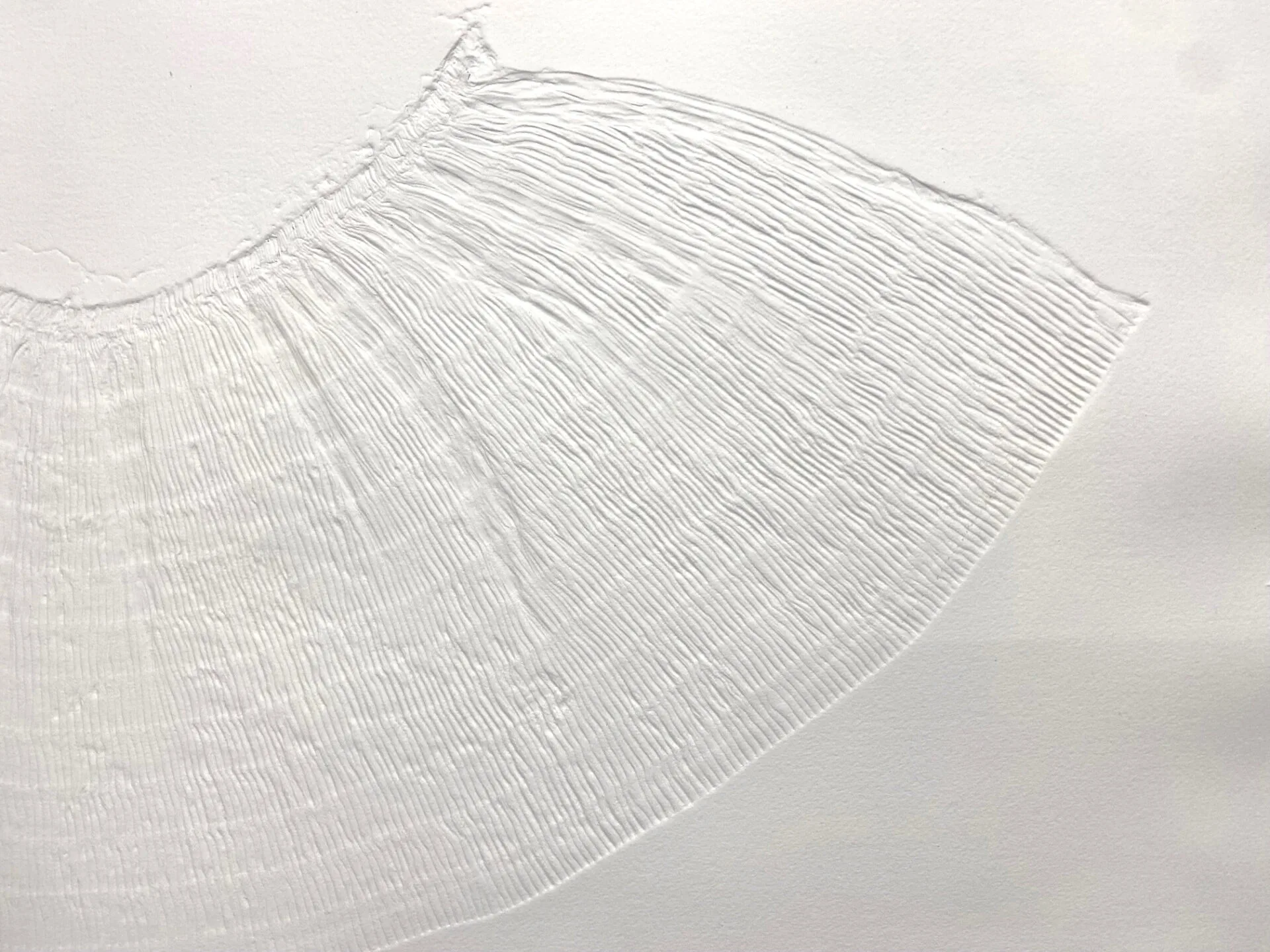
The things we conjure up on our screens, whether words or images, are present in a kind of absence. It seems like they’re there, we think they’re there, but they’re not. We take what we see on our screens as reality, dismissing questions of representation by accepting the screen as a window rather than a veil. We project onto it what isn’t there (the reality of the thing represented) by abstracting what is actually “there”: pixels.
During this residency, I set out to materialize and sample the pixelated fabrics of various screens, and to delve into the deeper aesthetics of certain tools of the written word. At first, I thought pixels would be square, similarly sized, and stuck one against the other. I couldn’t have been more mistaken. With their different shapes and colors, each screen contains a microworld that usually resists our gaze and our questions. I found space between the pixels, places in the screen from which no light emerges, and realized that text (black-on-white) extinguishes pixels, almost directing the eye beyond the screen, behind the veil. For this exhibition, I translated my digital photographic research into a series of photo etchings, augmented by the techniques of aquatint and intaglio printmaking, ghost or superimposed prints, letterpress, video installation, performance and sculpture.
Raphaëlle Groulx-Julien
Raphaëlle Groulx-Julien lives and works in Montreal. She has just completed her master’s degree in visual and media arts at UQAM (2024), where she also completed her bachelor’s degree (2020). Her final exhibition, L’étant aimé, was presented at the Popop gallery in January 2024. She has been participating in group and self-managed exhibitions in Montreal since 2016. She also presented her work in New York in a two-phase group exhibition, at the Atlantic Gallery in August 2021, and at the Jill Krutick Fine Art Gallery in October of the same year. She participated in the third edition of Artch in 2020. Her images have been published in Canadian Art (winter 2021), Item (spring 2022), and Le Devoir (May 16, 2020). She wrote an article to be published in Esse in the fall of 2024.
Recipient of the François-Xavier Marange Scholarship in Printing Arts, she has been in residence at the Atelier Circulaire since September 2023.
My approach consists of trying to capture the furtive wonders that I experience daily. Reflections, effects of lights and shadows, textures, flowers coming out of the pavement, bright colors of advertising images whose messages I don’t know: I am intrigued by the contrast that marks the almost trivial nature of what I am looking at, and the emotion that these visions provoke. They make me switch from the banal to the magical. In my practice, I question the source of my wonder, and what it says about my relationship to the world.
I choose ordinary subjects, such as tea brewing or photographs of plants I pass on the street, and I work with residual objects, scraps, counter-forms of other projects. I make them pass through the filter of a precious materiality, to make a shift towards the marvellous.
To achieve this, I use traditional, often old techniques, that require attention, a significant investment of time, and sometimes specialized training – for example for the use of colored clays or the application of gold leaf. I adopt a multidisciplinary approach, based on mastering techniques and gestures, and on knowledge of the materials and mediums I work with. In my corpus, I seek to create a discussion between different techniques and materialities. I explore the hypothesis that it is the links and contrasts resulting from this interplay between the mundane and the precious, the raw and the meticulous, that create the surprise that is the foundation of wonder.
The print artist, typographer, poet and playwright Tucker Kapp is currently a doctoral candidate at the University of Québec in Montreal in Studies and Practices of the Arts and artist in residence at Workshop Circulaire. His research investigates how tools (manual/corporeal, mechanical or digital) condition the work of the artist or writer, mechanically altering their relationship to creative processes. Originally from the United States and an occasional Montrealer, he lives in rural France where he runs a small press publishing house, Les Écrits 9.
My artistic practice is multidisciplinary and multimedia, associating the printing arts, creative writing, artist-book and small press publications, performance and theatre. Deeply invested in a continual process of research-creation, my creative work questions the socio-political, economic and aesthetic issues of our time. I pay particular attention to textuality and its textures, to representations and processes of knowledge, to questions of identity and their critique, to the uniqueness that emerges within seriality (especially in mechanical printing techniques), to technology and analog/digital cohabitation. Whether with writing, theatre, or more purely visual work, I try to make metaphors literal and blur conceptual frameworks enough so that they suggest rather than name. Through suggestion, logical and linguistic common sense is upended, opening us up to various and divergent meanings. As an intuitive and evocative means of communication, suggestion frees interpretation and dismantles expectation. Evoking without circumventing, situating without imposing, is the imaginative goal of the work.
As a printer and typographer for over ten years, I have discovered in the manual and profoundly processual work of printing a way to embrace constraint, to physically anchor the often ethereal word, and to say without saying, typographical composition being accomplished in silence. By choosing self-limiting reproductive techniques, I am mechanically inclined towards a spirit of degrowth that contrasts with the productivist injunctions that abound.
As a doctoral candidate in Studies and Practices of the Arts at UQAM, my research focuses on the link between text and technology, and more specifically on poetic writing and the range of technical tools, from moveable type to generative AI, that modify, condition or prescribe certain ways of writing. If the poem “puts us in the world” as Guillevic wrote, and if, for Ricœur, “the text is the very place where the author happens”—the place where consciousness is conceived—it is essential to analyze the aesthetic structures of the advent of the word. In short: how consciousness is constituted by creation.
The François-Xavier Marange grant was created by Atelier Circulaire and the UQÀM Foundation in 2014. It aims to lead young artists to broaden their artistic approach and work in a professional environment.
Exhibition at the Gallery (space 105)
July 4 – July 27
Progressive performance for the duration of the exhibition
Finissage
July 27 from 5:00 p.m. to 9.pm. (presentation at 6:00)